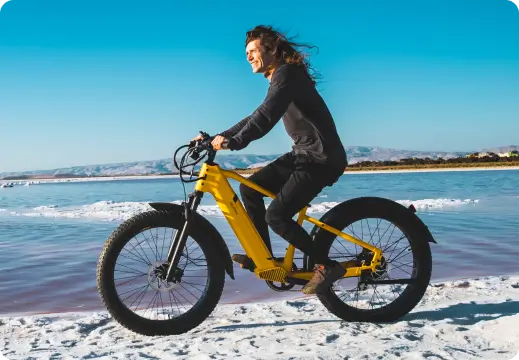






New York has become one of the fastest-growing eBike markets in the United States. From daily commuters riding through Manhattan to weekend cyclists exploring the Empire State Trail, electric bicycles have become a common way to travel, exercise, and reduce transportation costs.
While New York generally recognizes electric bicycles as bicycles rather than motor vehicles, its laws differ from those in many other states. The most notable difference is that Class 3 eBikes are currently authorized only in New York City, making it especially important for riders to understand where each type of eBike may be used.
Whether you're a New York resident or planning to visit with your eBike, this guide explains how New York classifies electric bicycles, where they're allowed, and what riders should know before heading out.

New York eBike Laws at a Glance
If you're looking for a quick overview, here's what New York law says about electric bicycles.
| Requirement | New York Law |
|---|---|
| Driver's License | ❌ Not required |
| Registration | ❌ Not required |
| Vehicle Title | ❌ Not required |
| Insurance | ❌ Not required |
| Minimum Rider Age | 16 years old |
| Helmet | Required for all Class 3 riders; additional local requirements may apply |
| Legal eBike Classes | Class 1, Class 2, Class 3 |
| Maximum Motor Power | 750 watts |
| Maximum Assisted Speed | 20 mph (Class 1 & 2), 25 mph (Class 3) |
New York generally treats qualifying electric bicycles the same as traditional bicycles. However, some operating rules—particularly for Class 3 eBikes—differ from those found in most other states.
What Is Legally Considered an Electric Bicycle in New York?
Before looking at where you can ride, it's important to understand what New York law considers an electric bicycle.
Under New York Vehicle and Traffic Law, an electric bicycle must:
- Have fully operable pedals.
- Be designed for human power with electric assistance.
- Have an electric motor rated at 750 watts or less.
- Fall within the state's Class 1, Class 2, or Class 3 eBike classification system.
- Display a manufacturer label identifying its class, top assisted speed, and motor wattage.
Only bicycles that meet these requirements are legally recognized as electric bicycles. Once a vehicle exceeds these limits—or no longer meets the legal definition—it may be regulated differently under New York law.
Electric Bicycle vs. Motorized Vehicle
One of the most common misunderstandings is that every electric two-wheeled vehicle is legally considered an eBike. In reality, New York distinguishes between electric bicycles and other motorized vehicles.
| Electric Bicycle | Motorized Vehicle |
|---|---|
| Fully operable pedals | May not have functional pedals |
| Motor rated at 750 watts or less | May exceed 750 watts |
| Falls within Class 1, 2, or 3 | Outside the three-class system |
| Generally treated as a bicycle | May require registration, licensing, or insurance |
This distinction has become increasingly important as higher-powered electric motorcycles and off-road electric vehicles continue to grow in popularity. Before purchasing an electric two-wheeled vehicle, make sure it qualifies as an electric bicycle if you plan to ride under New York's bicycle laws.
New York's Three-Class eBike System
Like many states, New York recognizes three classes of electric bicycles. Each class has different speed capabilities, and one category has a unique restriction that applies only within New York State.
| Class | Motor Assistance | Maximum Assisted Speed |
|---|---|---|
| Class 1 | Pedal assist only | 20 mph |
| Class 2 | Pedal assist or throttle | 20 mph |
| Class 3 | Pedal assist only | 25 mph |
All three classes must use a motor rated at 750 watts or less.
Class 1 eBikes
Class 1 electric bicycles provide pedal assistance only, with motor assistance stopping once the bicycle reaches 20 mph. They are the most widely accepted category and are generally permitted anywhere traditional bicycles are allowed unless a local regulation states otherwise.
Class 2 eBikes
Class 2 electric bicycles can be powered either by pedaling or by a throttle, but motor assistance is still limited to 20 mph. These bikes are popular with commuters and riders who frequently stop and start in city traffic.
Class 3 eBikes
Class 3 electric bicycles provide pedal assistance up to 25 mph and are intended for faster urban transportation.
Unlike most other states, New York limits Class 3 operation to cities with a population of one million or more. At present, New York City is the only municipality that meets this requirement, making it the only location in the state where Class 3 eBikes are authorized under current law.
Because of this unique rule, riders traveling outside New York City should be aware that Class 3 access is significantly more limited than Class 1 or Class 2.
Do You Need a Driver's License, Registration, or Insurance for an eBike in New York?
One of the biggest advantages of riding an electric bicycle is that qualifying eBikes are not treated like motor vehicles under New York law.
If your eBike falls within the legal Class 1, Class 2, or Class 3 definitions, you do not need:
- A driver's license
- Vehicle registration
- A vehicle title
- Mandatory liability insurance
Instead, qualifying electric bicycles are generally regulated in the same way as traditional bicycles.
However, this exemption only applies to bicycles that meet New York's legal definition of an electric bicycle. Higher-powered electric vehicles, mopeds, and motorcycles may be subject to completely different licensing and registration requirements.
Helmet Laws for eBike Riders in New York
Helmet requirements vary depending on both the rider and the type of electric bicycle being operated.
Under New York law:
- All riders under 16 years old are prohibited from operating an electric bicycle.
- All Class 3 eBike riders must wear a helmet, regardless of age.
- Riders aged 16 and older operating Class 1 or Class 2 eBikes are generally not required by state law to wear a helmet unless another local requirement applies.
- In New York City, employers of commercial delivery riders must also provide helmets in accordance with local regulations.
Although helmets are not legally required for every rider, they remain one of the most effective ways to reduce the risk of serious head injuries. Wearing a properly fitted bicycle helmet is strongly recommended whenever you ride, especially in busy urban environments or on higher-speed roads.
Minimum Age Requirements
New York has one of the clearest statewide age requirements for electric bicycles.
To legally operate any electric bicycle in New York, a rider must be at least 16 years old. Unlike many other states that set different age limits for different eBike classes, New York applies this minimum age requirement across all legal electric bicycle classifications.
Parents should also remember that children under 16 may still ride as passengers on properly equipped bicycles when permitted by the manufacturer, but they may not legally operate an electric bicycle themselves.
Where Can You Ride an eBike in New York?
New York provides broad access for electric bicycles, but where you can ride depends on both state law and local regulations. Here's a general overview.
| Location | Are eBikes Allowed? |
|---|---|
| Public roads | ✅ Yes |
| Bike lanes | ✅ Yes |
| Shared-use paths | ✅ Generally permitted |
| Sidewalks | ❌ Generally prohibited |
| New York State Parks | ⚠️ Depends on park regulations |
| Empire State Trail | ⚠️ Depends on trail segment |
| New York City Greenways | ✅ Generally permitted where bicycles are allowed |
| Private property | Depends on the property owner |
Always obey posted signs, speed limits, and local restrictions, as municipalities and land managers may establish additional rules beyond state law.
Public Roads and Bike Lanes
Class 1 and Class 2 electric bicycles may generally operate on public roads and bicycle lanes wherever traditional bicycles are allowed.
Within New York City, Class 3 eBikes may also use bike lanes and streets that permit bicycle traffic, provided riders comply with all posted speed limits and local traffic regulations.
Like conventional cyclists, eBike riders must obey traffic signals, ride in the direction of traffic, and yield when required.
Shared-Use Paths and Greenways
Many of New York's shared-use paths welcome electric bicycles, particularly Class 1 and Class 2 models.
However, individual trail managers may establish their own operating rules, including:
- Speed limits
- Yield-to-pedestrian requirements
- Restrictions during crowded periods
- Limitations on certain classes of eBikes
One of the best-known examples is the Hudson River Greenway in Manhattan, where riders should expect lower speed limits and heavy pedestrian traffic throughout much of the route.
Empire State Trail
The Empire State Trail stretches more than 750 miles across New York, making it one of the country's largest statewide trail systems.
Electric bicycles are permitted on many sections where traditional bicycles are allowed. However, because the trail passes through state parks, local municipalities, rail trails, and other managed properties, individual segments may have different operating rules.
Before beginning a long-distance ride, it's a good idea to check the regulations for the specific trail section you plan to use.
New York State Parks
Many New York State Parks allow electric bicycles in areas where traditional bicycles are permitted, particularly on paved roads and designated bicycle routes.
Access to natural-surface trails, recreational paths, and other facilities may vary by park.
Because each park may establish its own operational policies, riders should always review the current rules before visiting.
Sidewalks
Electric bicycles are generally not permitted on sidewalks unless specifically authorized by local law.
This rule is particularly important in New York City, where sidewalk riding is heavily restricted for both traditional bicycles and eBikes due to pedestrian safety concerns.
Whenever bicycle infrastructure is available, riders should use designated bike lanes or operate on the roadway in accordance with traffic laws.
Why New York City Is Different
Although New York State establishes the legal framework for electric bicycles, New York City operates under several additional rules because of its size, population density, and transportation network.
Most notably:
- New York City is the only municipality where Class 3 electric bicycles are authorized under state law.
- Since October 2025, New York City has enforced a citywide 15 mph speed limit for all eBikes, regardless of class, across all five boroughs — including on park pathways. This is separate from, and lower than, the state's 25 mph Class 3 assist limit.
- Commercial delivery riders must comply with additional safety requirements established by the New York City Department of Transportation.
- Certain parks, plazas, waterfront paths, and public spaces may have their own operating restrictions or designated cycling hours.
Because local rules can change, riders should always check the latest guidance published by NYC DOT before riding in unfamiliar areas.
Why Velotric eBikes Are a Great Fit for New York Riders
New York riding is incredibly diverse. One day you may be commuting through Midtown traffic, while the next you're cruising along the Hudson River Greenway or spending a weekend exploring sections of the Empire State Trail. Choosing an eBike that adapts to different riding environments can make every trip more enjoyable.
Velotric designs its eBikes with that versatility in mind.
For everyday commuting, the Velotric Tempo offers a lightweight, bike-like riding experience that's easy to maneuver through city streets, navigate apartment buildings, and carry up stairs when needed.

And it features One-Touch Class Switching, allowing riders to configure their bike as Class 1, Class 2, or Class 3 where permitted by law. Velotric Tempo also include a removable throttle, giving riders additional flexibility while helping them comply with local riding regulations.
FAQs About New York eBike Laws
Do you need a driver's license to ride an eBike in New York?
No. Riders do not need a driver's license, vehicle registration, title, or insurance for electric bicycles that meet New York's legal Class 1, Class 2, or Class 3 definitions.
Are eBikes legal in New York?
Yes. New York recognizes Class 1, Class 2, and Class 3 electric bicycles, although Class 3 operation is currently authorized only in New York City under state law.
Can you ride an eBike on sidewalks in New York?
Generally, no. Electric bicycles are prohibited on sidewalks unless specifically allowed by local ordinance. Riders should use bike lanes or operate on the roadway where bicycles are permitted.
Can you ride an eBike in Central Park?
Yes. Electric bicycles are generally allowed wherever bicycles are permitted within Central Park. Riders must obey all posted speed limits, traffic controls, and park regulations.
Can you ride an eBike on the Empire State Trail?
Many sections of the Empire State Trail permit electric bicycles where traditional bicycles are allowed. Because the trail passes through different jurisdictions, some sections may have additional restrictions or operational rules.
Can tourists ride an eBike in New York?
Yes. Visitors may legally ride qualifying electric bicycles without obtaining a New York driver's license, provided they follow all applicable state and local regulations.
Can an eBike have a throttle in New York?
Yes. Class 2 electric bicycles may use a throttle with motor assistance up to 20 mph. Riders should always ensure their bicycle complies with New York's legal classification requirements.
Why is Class 3 different in New York?
Unlike most states, New York law authorizes Class 3 electric bicycles only in cities with populations exceeding one million. At present, New York City is the only municipality that meets this requirement.
Legal Notice: This article provides general educational information and is not legal advice. New York laws and local regulations may change over time, and cities, counties, parks, trail authorities, and public agencies may establish additional restrictions beyond state law. Always verify the latest requirements with the appropriate government agency before riding.